How to Calculate Hamper Packaging Cost: A Complete Guide for Hamper Businesses in India
How to Calculate Hamper Packaging Cost: A Complete Guide for Hamper Businesses in India
Starting a hamper business or already creating customised gift hampers for weddings, festivals and corporate clients?
One of the biggest mistakes hamper businesses make is calculating the cost of products inside the hamper but ignoring the actual cost of packaging.
A beautiful hamper is not just about chocolates, dry fruits, candles or skincare products. The basket, tray, ribbons, fillers, wrapping materials, decorative accessories and labour all contribute to the final cost.
If you don't calculate these expenses properly, you may end up quoting a price that looks profitable but actually leaves very little margin.
Whether you are a wedding planner, corporate gifting company, hamper manufacturer, retailer or gifting entrepreneur, understanding how to calculate hamper packaging cost is essential for running a profitable business.
In this guide, we will break down every component of hamper packaging cost, explain the calculation formula and show you how to price your hampers correctly.
1. What Is Hamper Packaging Cost?
Hamper packaging cost is the total amount spent on materials and labour required to assemble, decorate and prepare a gift hamper for delivery.
It includes more than just the basket or box.
A typical hamper packaging setup may include:
Basket, tray or gift box
Inner lining or fabric
Tissue paper and shredded paper fillers
Ribbons and decorative bows
Personalised tags and labels
Decorative accessories
Wrapping materials
Labour and assembly charges
Protective packaging for transportation
For businesses creating multiple hampers every day, even a small difference in packaging cost can significantly affect overall profitability.
2. List All the Components of Hamper Packaging
Before calculating the final cost, prepare a list of every item used in the packaging.
Here is a breakdown of common hamper packaging materials.
A. Main Packaging Container
This is usually the biggest component of your packaging budget.
Examples include:
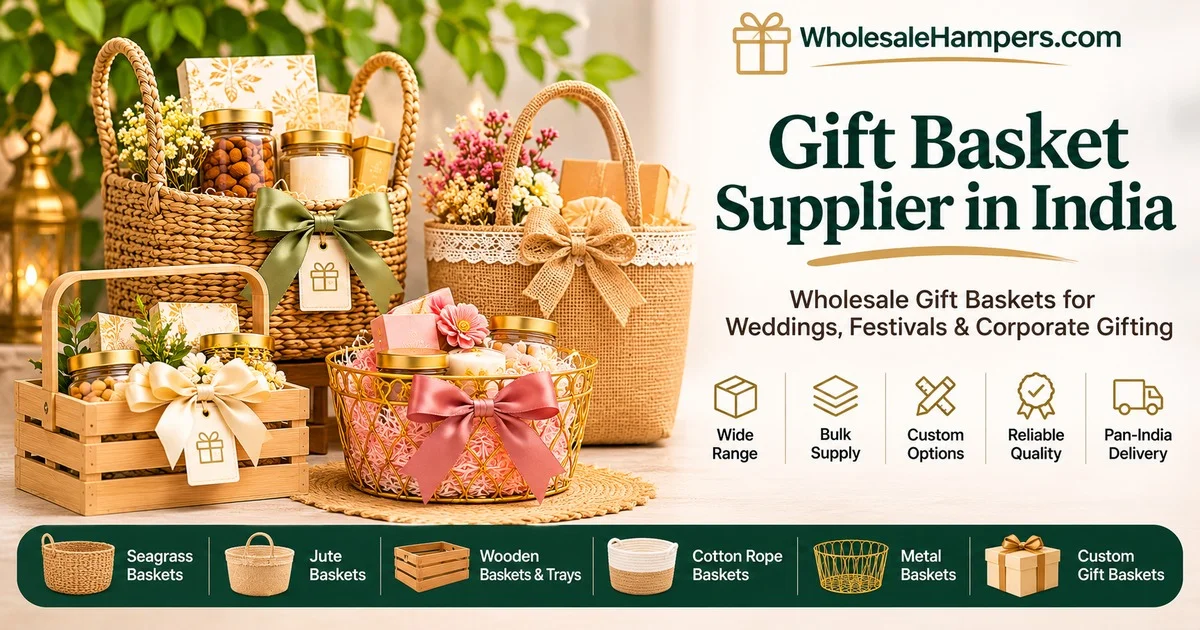
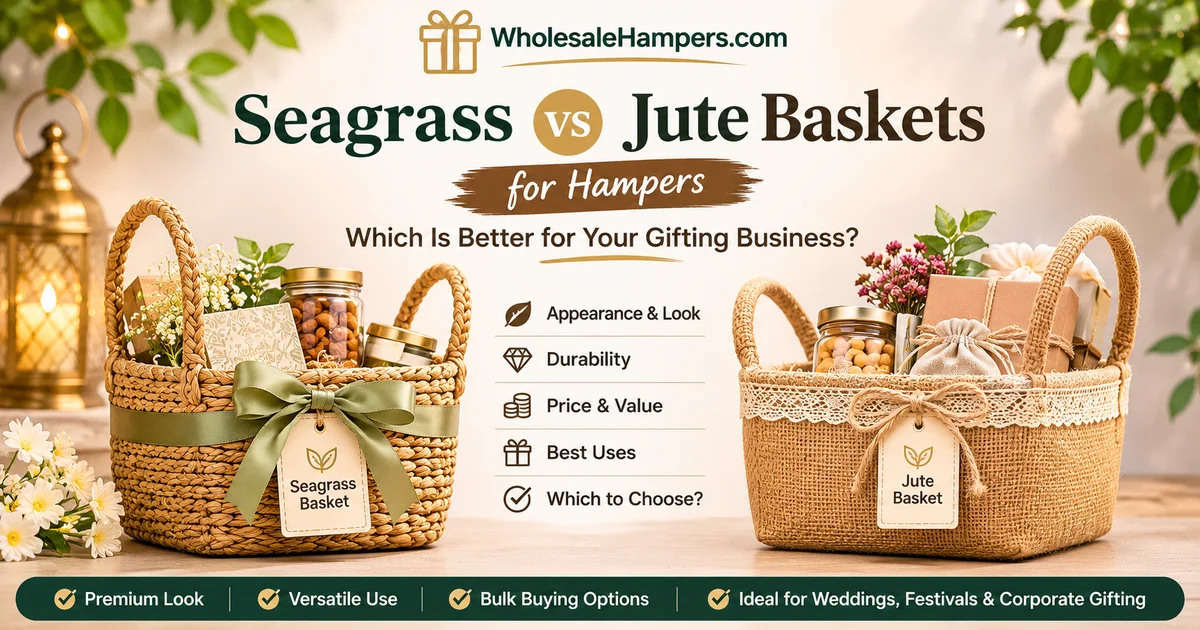
Jute baskets
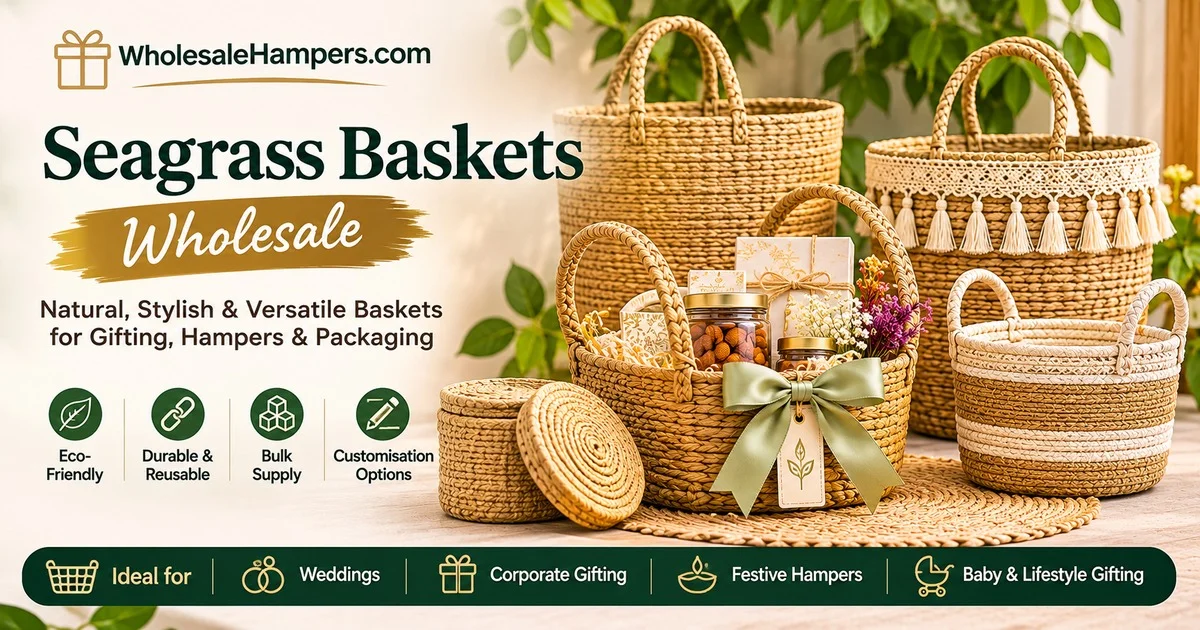
Seagrass baskets
Wooden trays
MDF boxes
Pinewood baskets
Metal platters
Cotton rope baskets
Fabric baskets
Vegan leather trays
Decorative gift boxes
The container cost depends on its size, material, design, finishing and purchase quantity.
B. Inner Filling and Cushioning
Fillers make the hamper look fuller and help position products neatly.
Common materials include:
Shredded paper
Crinkle paper
Tissue paper
Fabric lining
Satin cloth
Foam sheets
Protective cushioning
Remember to calculate the actual quantity consumed per hamper rather than the total price of the material packet.
C. Decorative Accessories
Decorative elements improve the presentation of the hamper.
These may include:
Satin ribbons
Lace
Decorative bows
Artificial flowers
Dry flowers
Personalised tags
Stickers
Hang tags
Wooden name cutouts
Acrylic embellishments
D. Wrapping and Finishing Materials
The final presentation often requires additional materials.
Examples:
Transparent wrapping sheets
Shrink film
Cellophane sheets
Net fabric
Organza
Protective sleeves
Adhesive tape
Glue sticks
Cable ties
E. Labour and Assembly Cost
This is one expense that many small hamper businesses forget to include.
Consider the time required for:
Preparing the basket
Arranging products
Filling and cushioning
Tying ribbons
Attaching tags
Final decoration
Quality checking
Packing for dispatch
Even if the work is completed by your own team, labour has a cost and should be included.
3. Hamper Packaging Cost Calculation Formula
The basic formula is:
Total Hamper Packaging Cost = Container Cost + Filling Cost + Decoration Cost + Wrapping Cost + Labour Cost + Other Direct Costs
For a more accurate business calculation, also include wastage and an appropriate allocation of overhead expenses.
Here is the complete formula:
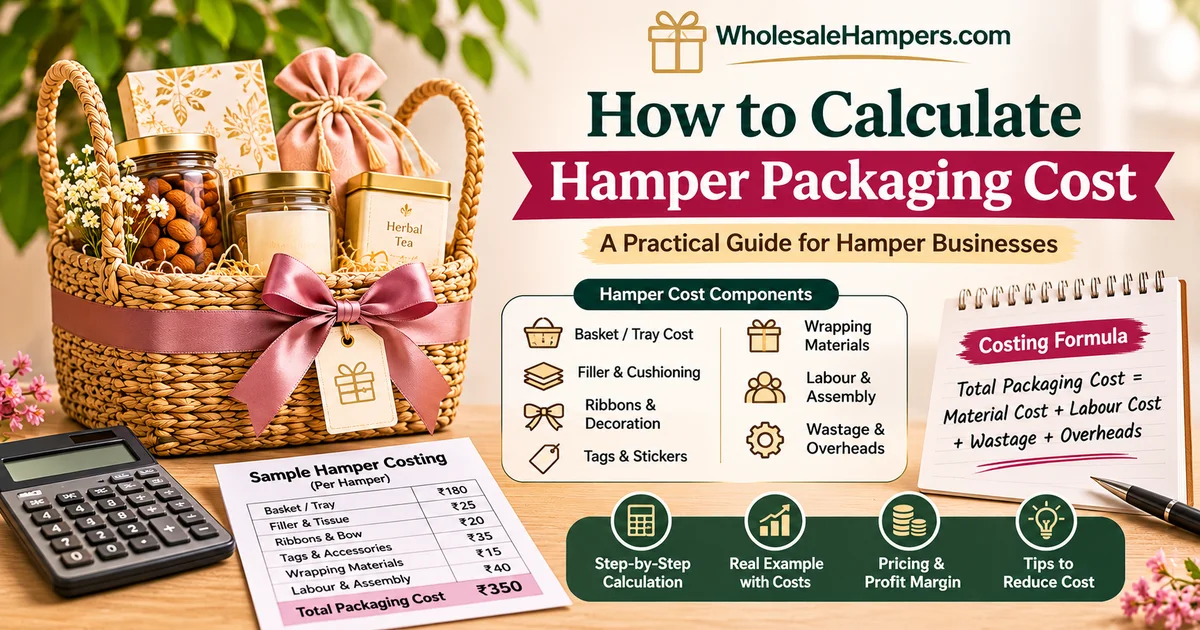
Total Packaging Cost = Material Cost + Labour Cost + Wastage + Allocated Overheads
Let's understand this with an example.
4. Practical Example: Calculate the Cost of One Gift Hamper
Suppose you are preparing a premium gift hamper using a seagrass basket.
Here is an illustrative cost breakdown:
Packaging component | Cost per hamper |
|---|---|
Seagrass basket | ₹180 |
Tissue paper and filler | ₹25 |
Satin ribbon and bow | ₹20 |
Personalised tag | ₹10 |
Decorative accessories | ₹25 |
Transparent wrapping | ₹15 |
Adhesive and consumables | ₹5 |
Labour and assembly | ₹40 |
Total direct cost | ₹320 |
In this example, the direct packaging cost is ₹320 per hamper.
Now add:
Additional expense | Cost |
|---|---|
Wastage allowance (5% of materials) | ₹14 |
Allocated overhead | ₹16 |
Total additional expense | ₹30 |
Therefore:
Total Hamper Packaging Cost = ₹320 + ₹30 = ₹350
Your actual packaging cost is ₹350 per hamper.
This is the amount you should consider while calculating your final selling price.
Note: These figures are illustrative, not market quotations. Actual prices depend on material, supplier, order quantity and design.
5. How to Calculate Hamper Packaging Cost for Bulk Orders
Bulk orders require a slightly different approach.
Suppose a corporate client orders 200 hampers.
Your estimated packaging cost is ₹350 per hamper.
The calculation becomes:
Particulars | Amount |
|---|---|
Number of hampers | 200 |
Packaging cost per hamper | ₹350 |
Total packaging cost | ₹70,000 |
If you negotiate better rates on baskets and decorative materials for the bulk order, your actual cost per hamper may reduce.
For example, if bulk procurement reduces the basket cost by ₹20 per unit:
Original packaging cost: ₹350
Saving per hamper: ₹20
Revised packaging cost: ₹330
Saving on 200 hampers: ₹4,000
This is why sourcing packaging materials at wholesale prices can make a meaningful difference to your profit margins.
6. How to Calculate Hamper Selling Price and Profit Margin
Knowing your packaging cost is only the first step. You also need to calculate your final selling price.
Let's assume the following:
Cost component | Amount |
|---|---|
Products inside hamper | ₹1,000 |
Packaging cost | ₹350 |
Assembly and other costs | ₹50 |
Total cost | ₹1,400 |
Now suppose you want a 30% gross margin.
Do not simply add 30% to your cost.
Use this formula:
Selling Price = Total Cost ÷ (1 - Desired Profit Margin)
Therefore:
₹1,400 ÷ 0.70 = ₹2,000
Your selling price should be ₹2,000 before applicable taxes and any additional charges not already included in the cost.
Your gross profit is ₹600, which represents a 30% margin on the selling price.
Margin vs Markup: Understand the Difference
These two terms are often confused.
Markup: Profit calculated as a percentage of cost.
Margin: Profit calculated as a percentage of selling price.
For example, a 30% markup on ₹1,400 gives a selling price of ₹1,820.
But the gross margin on that selling price is only approximately 23.1%.
Understanding this difference is particularly important when quoting large corporate and wedding hamper orders.
7. Common Mistakes Hamper Businesses Make While Calculating Packaging Cost
Many hamper businesses struggle with profitability not because they lack orders, but because they underestimate their actual costs.
Here are some common mistakes to avoid.
1. Ignoring labour costs
Just because your team is already employed does not mean assembly labour is free.
2. Not calculating material wastage
Ribbons, wrapping sheets, fillers and decorative materials often have leftover portions that cannot be reused.
3. Ignoring small accessories
Tags, stickers, glue, tapes and other consumables may seem inexpensive individually but add up across large orders.
4. Using retail purchase prices for costing
Buying packaging materials in small quantities can increase your per-piece cost. Explore wholesale basket suppliers and bulk packaging procurement.
5. Forgetting transportation expenses
Large baskets and decorative trays can attract significant volumetric freight charges.
6. Quoting without a proper costing sheet
Never finalise a bulk hamper quotation based on rough estimates or memory.
7. Confusing markup with profit margin
Adding a percentage to the cost does not automatically give you the same percentage as your selling-price margin.
8. How to Reduce Hamper Packaging Costs Without Compromising Quality
Reducing packaging costs does not mean making your hampers look cheaper.
The objective should be to source smarter and use materials more efficiently.
Here are some practical strategies:
Buy Baskets and Trays Wholesale
Instead of purchasing baskets individually, source jute baskets, seagrass baskets, wooden trays and other containers through wholesale suppliers.
Bulk procurement can improve your per-piece buying cost.
Standardise Basket Sizes
Create a standard collection of basket sizes for small, medium, large and premium hampers.
This simplifies procurement, storage and assembly.
Use Common Decorative Elements
Maintain a standard range of ribbons, fillers and tags that can be used across multiple hamper designs.
Plan Material Consumption
Measure how much ribbon, filler and wrapping material is actually required for each design.
Avoid unnecessary overuse.
Design Reusable Packaging
Choose baskets and trays that customers can reuse after receiving the hamper. This can improve perceived gifting value.
Negotiate Bulk Procurement Rates
For recurring orders, negotiate better rates with suppliers based on expected volumes and repeat requirements.
9. Why Wholesale Packaging Procurement Matters for Hamper Businesses
For a hamper business, packaging is not just an expense. It is also an important part of the product's perceived value.
A well-designed basket can make even a simple collection of products look premium.
However, sourcing packaging materials at retail prices can reduce your profitability.
This is where wholesale sourcing becomes important.
At WholesaleHampers.com, our objective is to simplify wholesale basket and hamper packaging sourcing for businesses.
You can explore sourcing options across categories such as:
Jute baskets
Seagrass baskets
Wooden baskets and trays
Cotton rope baskets
Decorative gift baskets
Hamper packaging products
Whether you are a wedding planner, corporate gifting company, hamper entrepreneur or retailer, choosing the right wholesale packaging can help you manage procurement costs more effectively.
Looking for wholesale baskets and hamper packaging supplies? Explore WholesaleHampers.com.
10. Create a Standard Hamper Costing Sheet for Every Order
If you regularly prepare customised hampers, maintain a separate costing sheet for every design.
Your costing sheet should include:
Order number
Customer details
Hamper quantity
Basket or tray cost
Individual product costs
Filler and decoration costs
Labour charges
Wastage allowance
Transportation costs
Total cost per hamper
Selling price
Expected profit
Final profit margin
This will help you identify which hamper designs are actually profitable.
It will also make it easier to prepare quotations for wedding planners, corporate buyers and repeat customers.
Frequently Asked Questions About Hamper Packaging Cost
1. How do you calculate the packaging cost of a gift hamper?
Add the cost of the basket, filler, ribbon, tags, decorative accessories, wrapping materials, labour, wastage and allocated overhead expenses. Divide the total by the number of hampers to calculate the per-unit cost for a bulk order.
2. What is included in hamper packaging cost?
Hamper packaging cost includes the main container, internal cushioning, decorative materials, wrapping, labels, labour and other direct assembly expenses.
3. How much should I charge for hamper packaging?
There is no fixed price. Calculate the actual material and labour cost first, add applicable overheads, and then apply your desired selling margin.
4. How can I reduce hamper packaging costs?
Purchase baskets and decorative materials in bulk, standardise basket sizes, negotiate supplier rates, reduce material wastage and plan your packaging designs efficiently.
5. Is labour included in hamper packaging cost?
Yes. Labour should be included even if the work is performed by your own employees. It is an important part of the actual cost of assembling a hamper.
6. How do I calculate profit margin on gift hampers?
Subtract the total cost from the selling price and divide the result by the selling price.
Profit Margin (%) = [(Selling Price - Total Cost) ÷ Selling Price] × 100.
7. Why should hamper businesses buy baskets wholesale?
Wholesale procurement can help businesses access competitive per-piece pricing, improve sourcing efficiency and maintain consistent packaging options for recurring orders.
8. Where can I source wholesale baskets for gift hampers in India?
Businesses can explore wholesale basket manufacturers, suppliers and B2B sourcing platforms. WholesaleHampers.com aims to simplify bulk basket sourcing for gifting and packaging businesses.
Final Thoughts
A profitable hamper business is built on more than beautiful packaging and attractive products. It requires accurate costing, smart sourcing and proper pricing.
Every ribbon, basket, tag, filler and hour of labour contributes to the final cost.
Start calculating these expenses systematically, maintain a costing sheet for every hamper design and compare wholesale sourcing options before finalising your procurement.
And remember, the goal is not simply to create the most beautiful hamper. It is to create a beautiful hamper that also makes business sense.
Explore wholesale basket and packaging sourcing at WholesaleHampers.com.
Wholesale Baskets. Better Sourcing. Smarter Business.